

The dent is only part of the story
It's remarkable how much a small dent can change the way you look at your car. Perhaps it appeared after an unfortunate moment in a parking lot. The paint seems intact, and the car is otherwise in good condition. Yet you notice that dent every time the light falls across the door. The first thought is often the same: Does the entire panel really need to be sanded, repaired and repainted?
What appears to be a simple dent on the surface is actually a change in the shape of the metal. To repair it properly, you need to understand how the damage occurred and how the metal can return to its original form. That's where PDR begins.


THE HISTORY OF PDR
How did it all begin?
PDR is not a new idea. Behind the technology lies a long history of metalworking and attempts to repair damage without replacing or repainting entire panels.
In the first half of the 20th century, Frank T. Sargent wrote about how damage could be assessed and metal reshaped using a systematic approach. This knowledge became part of the foundation on which later repair techniques were built.
One of the best-known stories in the development of modern PDR involves Oskar Flaig, an employee of Mercedes-Benz.
According to a well-known account, at a car show in New York in 1960, he pushed out a small dent using the handle of a hammer. Initially, his intention was simply to reduce the amount of work required for a conventional repair. But the result was so good that the damaged area did not need repainting.
From this simple idea, a specialised technique developed, using dedicated tools, lighting and repair methods.
The goal, however, has remained unchanged: to preserve as much of the vehicle's original condition as possible.
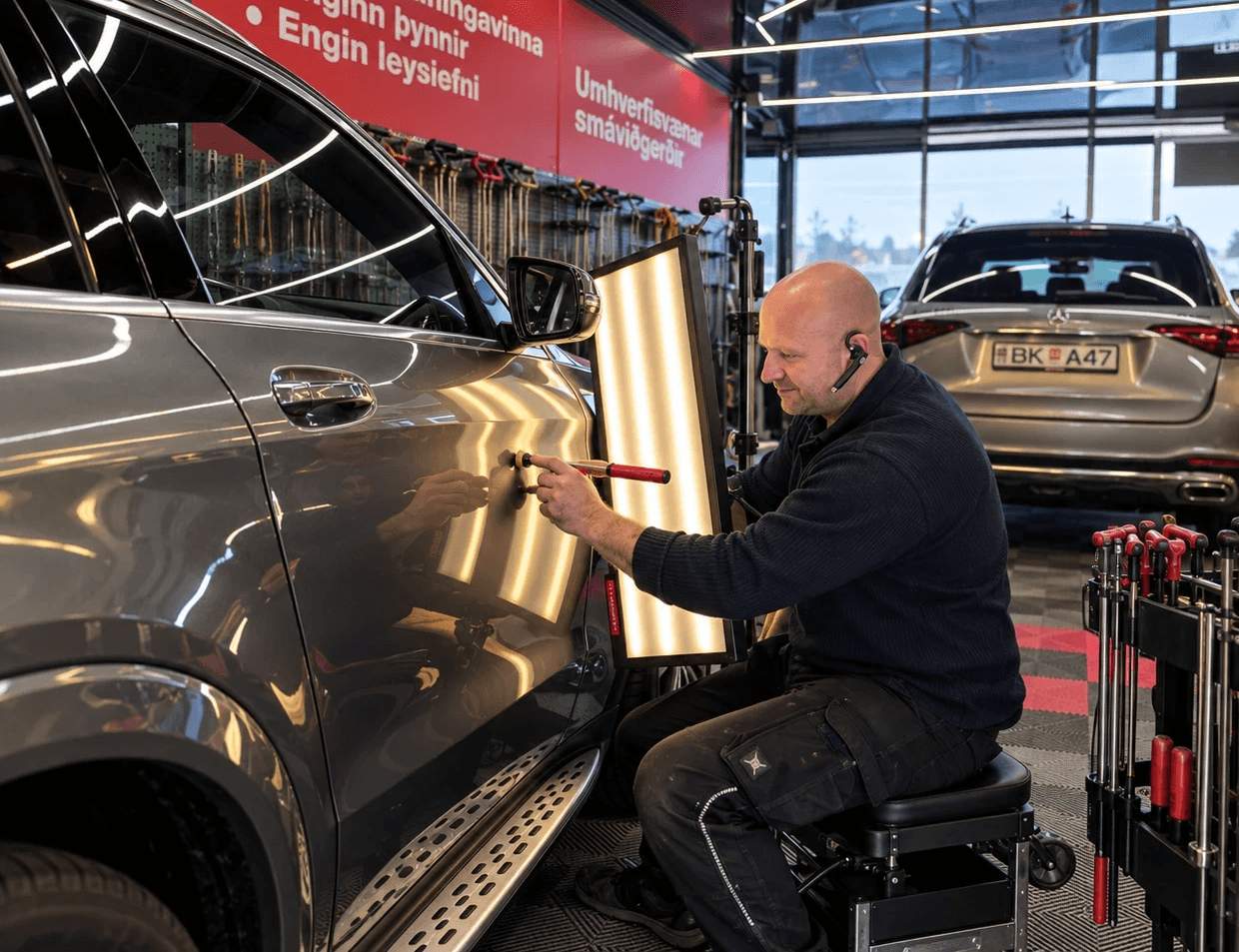

THE TECHNOLOGY BEHIND PDR
What the eye cannot see
WHY PDR?
Sometimes the greatest benefit is what you don't have to do.
When a dent can be repaired without repainting, the vehicle's original paintwork is preserved.
PAINT / TIME / COST
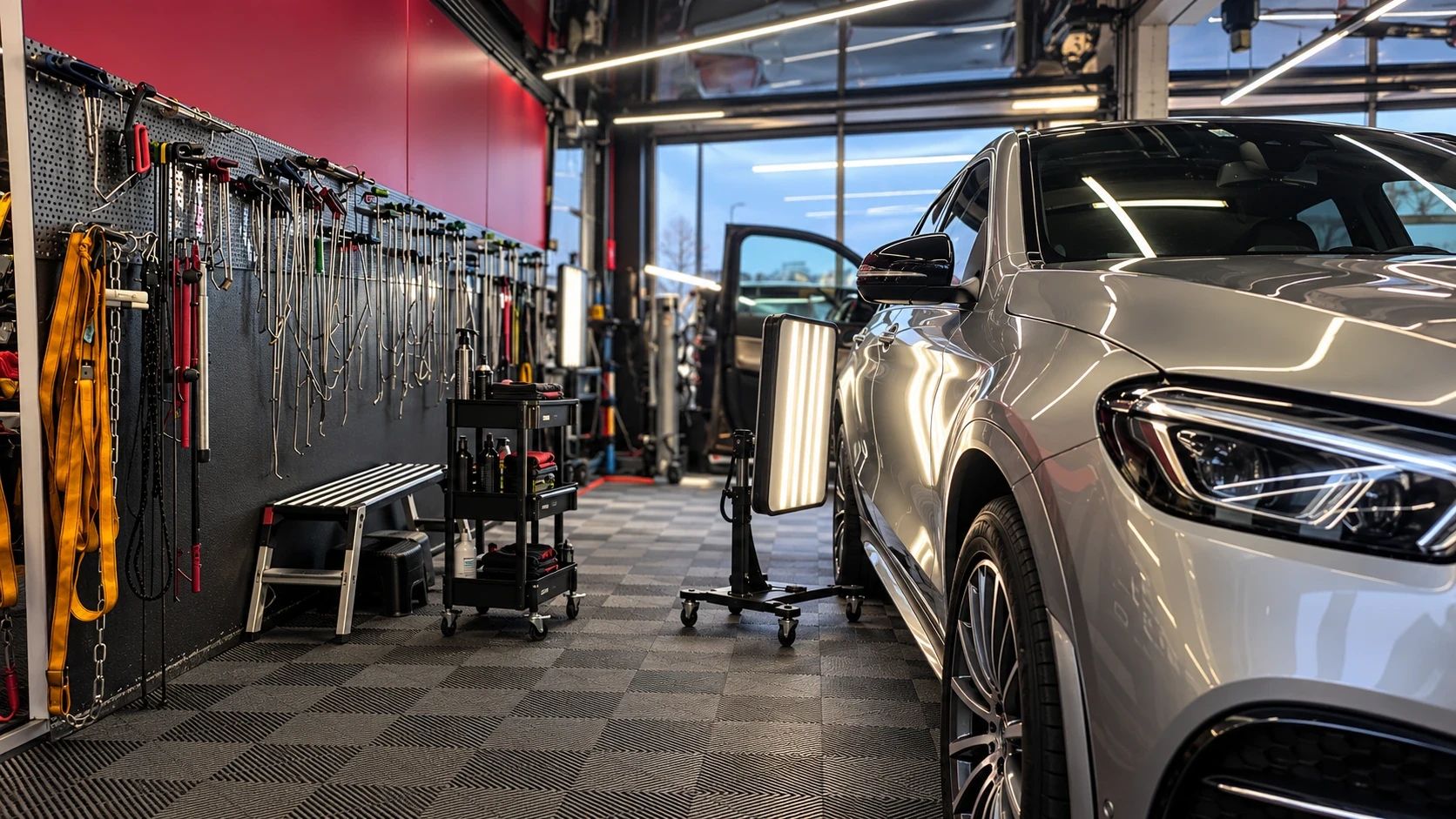

When conditions allow, there is no need to sand, apply filler or repaint the entire panel. This means less intervention and more of the vehicle's original condition is preserved.
For many, that is the greatest benefit. The original paintwork remains largely untouched, repair time is often shorter and the cost may be lower than with a conventional repair.
PDR is therefore not just about repairing a dent, but also about avoiding unnecessary work when the damage and condition of the paintwork allow it.
Sometimes the best repair is one that preserves more, requires less and delivers a cleaner result.
When the right method is chosen, the vehicle benefits from less intervention, a shorter repair process and more of its original appearance.
REAL PDR REPAIR
The results are best seen on the car itself.
Here you can see how damage can be transformed with PDR when conditions allow.
A before-and-after photo doesn't tell the whole story. Behind the result are an assessment of the damage, the choice of the right repair method and precise work on the panel.


FREQUENTLY ASKED QUESTIONS
What you want to know about PDR.
Find answers to the most common questions about PDR, assessing damage and the repair process before making a decision.
Can all dents be repaired without repainting?
No. It depends on the location and shape of the damage, the condition of the paintwork and how much the metal has stretched.
How long does a PDR repair take?
It depends on the size and complexity of the damage. Some repairs can take a short time, while others require more work.
Is PDR always cheaper than conventional body repair?
Not necessarily. It depends on the damage. When PDR is suitable, it can be more economical because sanding, filler and repainting are not required.
How do I know if PDR is suitable for my car?
The best way is to send us clear photos of the damage. They can help with an initial assessment, but sometimes the vehicle needs to be inspected in person to confirm the right solution.

